

Global Oil Prices Today: Live Oil Price Chart for January 5, 2026
Jakarta, Pintu News – Crude oil prices fell to $56.48 per barrel on January 5, 2026, down 1.47% compared to the previous day. In the past month, crude oil prices recorded a decline of 4.08%, and when compared to the same period last year, the decline reached 23.22%.
This data is based on the trading of contracts for difference (CFDs) that follow the benchmark market for this commodity. Historically, crude oil reached a record high of $410.45 in December 2025.
World Crude Oil Prices Today
West Texas Intermediate (WTI) crude oil prices have shown a consistent downward trend in recent days, with the daily movement chart (1D) recording a decline to $56.461 per barrel at the last close, down 0.058 points or about 0.103%.
Read also: Oil Prices Dip Following U.S. Military Operation in Venezuela
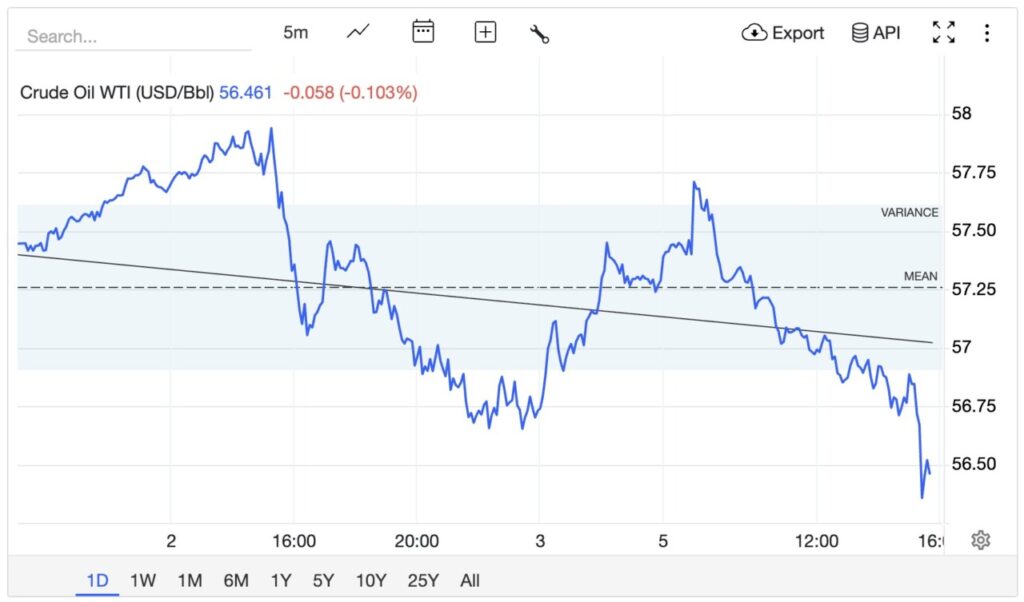
The chart indicates increasing selling pressure since early January, with prices moving below the mean line and getting closer to the lower boundary of the variance zone. The sharp drop came after the price briefly touched the $57.75 range, before finally correcting sharply and forming a clear downtrend.
This trend reinforces the bearish signal in the crude oil market, with prices currently also below the short-term trend line depicted in the chart. If the selling pressure continues, crude oil prices could potentially retest the lower support levels below $56, which could be a crucial point for the market’s next direction.
This reflects market concerns over global demand and potential oversupply, as economic and geopolitical data continue to influence investor sentiment.
Is there a crypto whose price is pegged to the world oil price?
For now, there are no major cryptocurrencies that are directly pegged to the world price of oil in the same way that stablecoins are pegged to the US dollar (e.g. USDT or USDC). However, there are several crypto projects and tokens that are inspired by or closely related to commodities like oil, especially in the context of tokenizing real-world assets (RWAs).
Gold-Based Crypto: More Popular and Stable

Unlike oil, gold has long been considered asafe haven asset and a store of value in uncertain market conditions. This makes gold more psychologically and fundamentally suitable as the underlying asset in commodity-based stablecoins. Some examples of gold-pegged cryptos include:
Read also: 3 Cryptos Highlighted by Analyst Ali Martinez at the Beginning of 2026
PAX Gold (PAXG)
- Pax Gold (PAXG) is pegged 1:1 to the price of one troy ounce of gold.
- PAXG is backed by physical gold stored in trusted vaults (Brinks).
- PAXG is issued by Paxos Trust Company and has received regulatory oversight in the US.
Tether Gold (XAUT)
- Tether Gold (XAUT) Issued by the issuer of USDT (Tether).
- Each XAUT token is backed by one troy ounce of gold stored in Switzerland.
That’s the latest information about crypto. Follow us on Google News to get the latest crypto news about crypto projects and blockchain technology. Also, learn crypto from scratch with complete discussion through Pintu Academy and stay up-to-date with the latest crypto market such as bitcoin price today, xrp coin price today, dogecoin and other crypto asset prices through Pintu Market.
Enjoy an easy and secure crypto trading experience by downloading Pintu crypto app via Google Play Store or App Store now. Also, get a web trading experience with various advanced trading tools such as pro charting, various types of order types, and portfolio tracker only at Pintu Pro.
*Disclaimer
This content aims to enrich readers’ information. Pintu collects this information from various relevant sources and is not influenced by outside parties. Note that an asset’s past performance does not determine its projected future performance. Crypto trading activities have high risk and volatility, always do your own research and use cold cash before investing. All activities of buying and selling bitcoin and other crypto asset investments are the responsibility of the reader.
Reference:
- Trading Economics. Crude Oil. Accessed on January 5, 2025